LASER · TONER
Drawn with light
A laser writes the page as an electrical image on a drum, which picks up powdered toner that heat then fuses to the paper.
Where it began
HOW HOME PRINTERS WORK
C M Y and black
AI-generated image, not a photograph of a real person or place.
The box on the desk is cleverer than it looks.
One kind draws your page with a laser and fuses powder onto it. The other fires tiny drops of liquid ink. Here is how both work, why A4 is the shape it is, and what the numbers on the box mean.
Plain English, with the sources linked.
LASER OR INKJET
Both are non-impact printers:
nothing strikes the page, unlike the old typewriter-style machines.
LASER · TONER
A laser writes the page as an electrical image on a drum, which picks up powdered toner that heat then fuses to the paper.
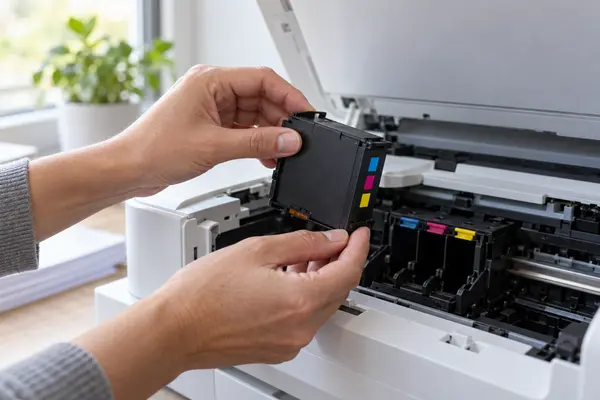
Where it beganINKJET · INK
An inkjet head fires tiny drops of liquid ink straight onto the sheet. Thermal inkjet reached desktops in 1984.
Cartridges and yieldPAPER · ISO 216
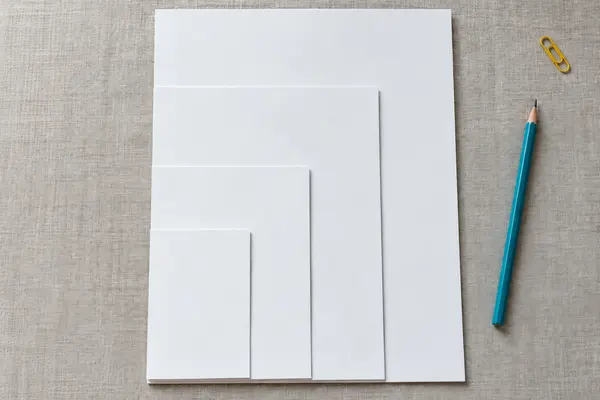
A-series paper keeps the same shape when you halve it, which is why A4 scales cleanly to A3 or A5.
Try the size explorer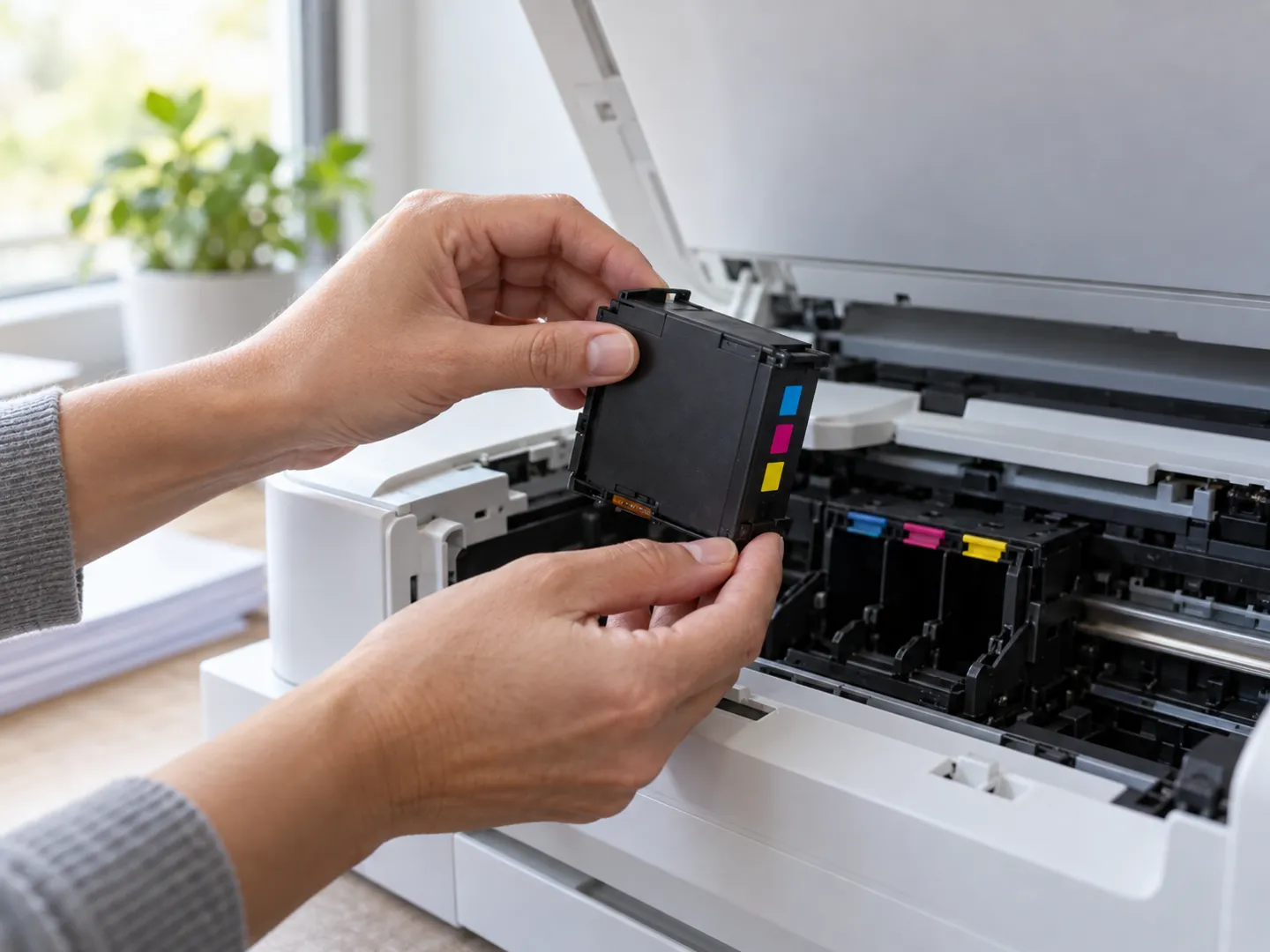
PRINT SMARTER
Energy-efficiency guidance recommends making sure duplex mode is enabled, so one sheet carries two pages.
Set the printer to drop into low-power sleep when idle, and switch off equipment you are not using rather than leaving it on standby.
Colour inkjet cartridge yields are measured under ISO/IEC 24711 with standard test pages on plain paper. Dividing price by yield gives a fairer comparison than price alone.
If you print a lot on a laser printer, keep the room well ventilated, as the 2007 particle researchers suggested.
TWO NUMBERS WORTH KNOWING
Laser printing arrived quickly,
and later research measured what some put in the air.
60 pages a minute
Prototype built from an office copier
Working at Xerox PARC, a physicist modified a standard copier into the first laser printer within about a year. The prototype printed 60 pages a minute at 500 dots per inch.
THE FIRST LASER PRINTER · 1971
17 of 62
Laser printers tested in Brisbane
Researchers at Queensland University of Technology classed 17 of 62 laser printers as high emitters of ultrafine particles. Emissions were higher with new toner cartridges and when printing graphics and images.
PARTICLES IN THE AIR · 2007
Emissions varied with printer model, age and cartridge. The researchers' practical advice until regulation caught up was simple: keep rooms with printers well ventilated.
PAPER SIZE EXPLORER
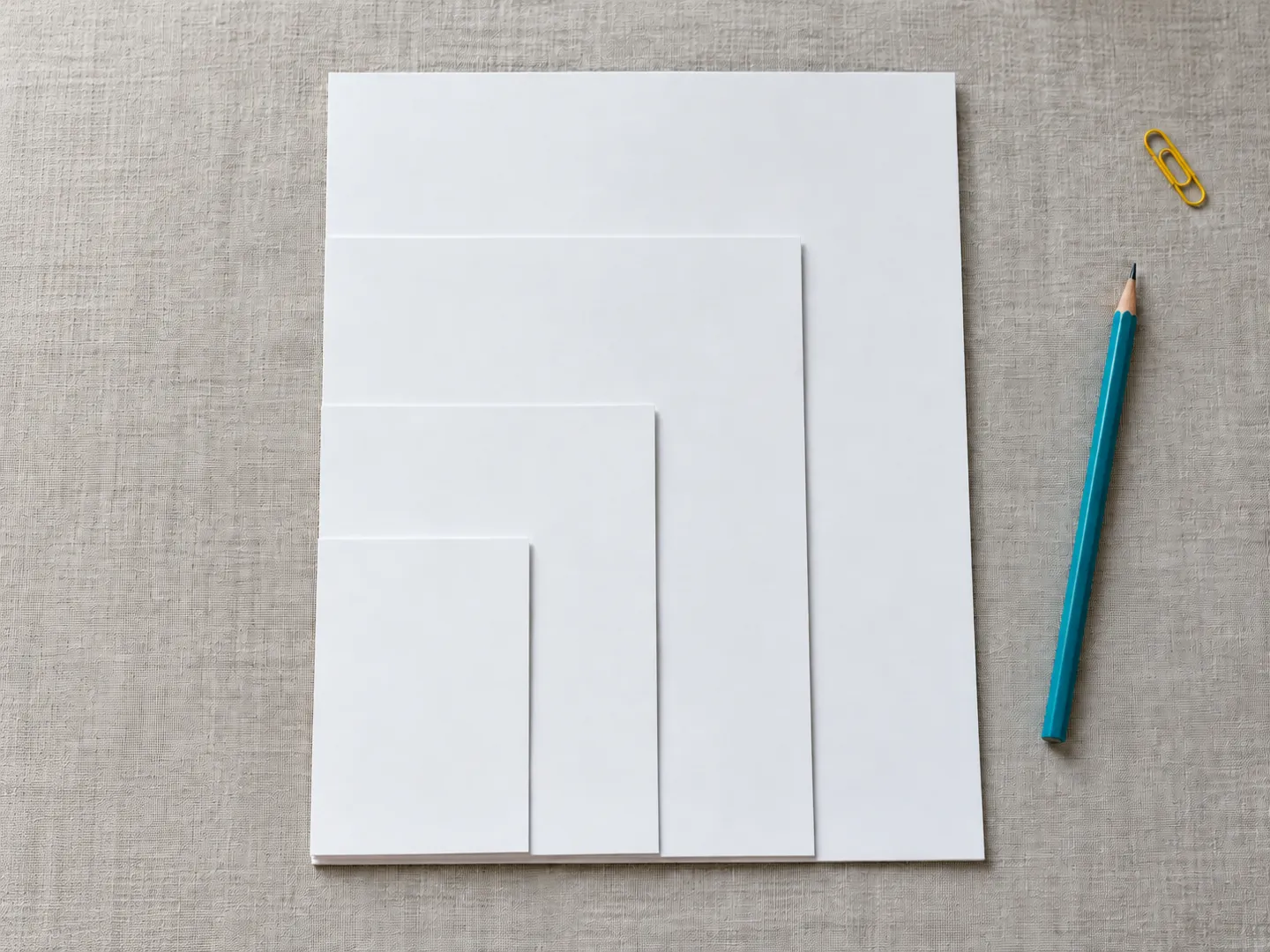
Pick a paper size to see its dimensions and how its area compares with A4. A-series sizes come from the international standard ISO 216, which defines A0 as one square metre.
Each A size is exactly half of the one above it, cut across the long side, and every one has sides in the ratio of the square root of two.
PRINTER FACTS
The idea of a sheet whose halves keep its shape goes back to a letter by Georg Christoph Lichtenberg in 1786. It became the German standard DIN 476 in 1922 and the international ISO 216 in 1975.
A0 has an area of one square metre. Halve it four times and you reach A4, at 210 by 297 mm.
Xerox researchers demonstrated laser printing in 1971, made it a networked office printer in 1974 and proved it commercially with the Xerox 9700 in 1977.
The first desktop printer to use thermal inkjet technology was introduced in 1984, bringing ink-drop printing to the office desk.
ENERGY STAR certified imaging equipment, such as printers, copiers and scanners, uses up to 35% less energy on average than standard models.
QUICK QUESTIONS
Short answers to the questions people ask most.
A laser printer uses a laser to draw the page as an electrical image on a drum, which picks up powdered toner that is fused onto the paper. An inkjet printer fires tiny drops of liquid ink straight onto the page.
Xerox researchers demonstrated laser printing in 1971 on a modified office copier, and the Xerox 9700 proved it commercially in 1977. Thermal inkjet reached desktops in 1984.
A-series sheets have sides in the ratio of the square root of two, so cutting one in half gives two sheets of the same shape. A0 has an area of one square metre, and A4 is A0 halved four times.
For colour inkjet cartridges, yield is measured under ISO/IEC 24711 by printing a defined suite of test pages on plain paper. It lets you compare cartridges fairly, but your own pages may use more or less ink.
A 2007 Queensland University of Technology study of 62 laser printers classed 17 as high particle emitters, with more emitted from new toner cartridges and when printing images. The researchers advised good ventilation.
Each figure on this page comes from the sources below.
A NAME THAT PRINTS WELL
doodleprinter.com is part of the DoodleSale portfolio. It isn't in an auction right now, but you can ask about leasing it.